
U.S Legislative Tailwinds Amid The Nuclear Renaissance
As of early 2026, the U.S. nuclear supply chain is undergoing its most radical transformation since the 1950s.
A shorter post today on the legislation pushing Nuclear forward, that opens opportunities at the enrichment, and fabrication levels. These stages seek to gain the most from federal investments as we recently saw in this $2.7B award to secure uranium enrichment domestically.
As with critical minerals, the nuclear industry is shifting from prioritizing low cost to geopolitical alignment. At the same time, the U.S. is seeking to modernize its nuclear infrastructure from Gen II (LEU or Low-Enriched Uranium) to Gen IV (HALEU i.e High-Assay Low-Enriched Uranium).
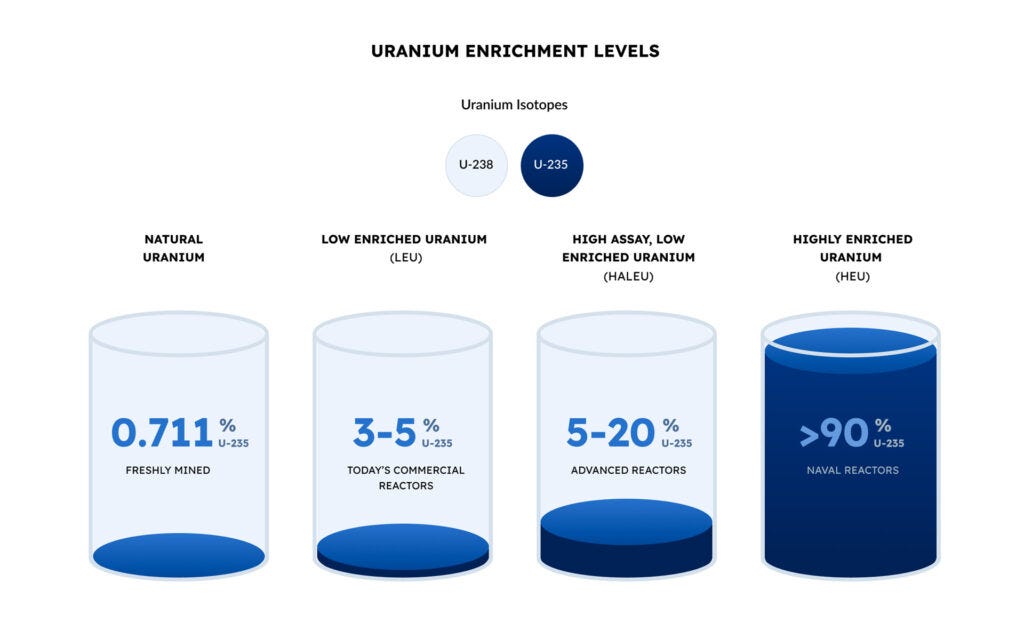
HALEU was largely imported up until 2024 when the U.S. banned certain uranium products from Russian entities through 2040 through the The Prohibiting Uranium Imports Act. Currently the Department of Energy is mandated to provide 21 metric tons but this presents some difficulties as the U.S supply chain is underdeveloped from years of importing, currently Centrus Energy ($LEU) is the only commercially licensed facility enriching HALEU fuel. Although there are some initiatives such as the Global Laser Enrichment by Silax & Cameco that could bypass multiple industry bottlenecks simultaneously and create a secondary supply by “re-enriching” depleted uranium tails.
U.S Government Legislation Tailwinds
To accelerate uptake and advancement of domestic supply chains, the U.S has been publishing various acts, and executive orders to mitigate geopolitical risk.
Mandates revisions to accelerate reviews of reactor licensing applications.
Lowers hourly rates allowing more participants (particularly startups or those that are less-established).
Streamlines deployment by re-utilizing grid connections from existing brownfield sites and retired fossil fuel sites.
Executive Order 14300 (May 2025)
Reduces NRC review time to 18 months from 4-6 years.
Establishes expedited pathway for already tested reactor designs within the DoE (Department of Energy) and DoD (Department of Defense/War).
HALEU Availability Mandate (June 30, 2026)
The DOE is mandated (via the HALEU Availability Program) to make available 21 metric tons of HALEU from its own inventories and new production by mid-2026
Execute Order 14301 (July 4th, 2026)
Sets criticality deadline for 3 new reactors
Streamlines final decision licensing to 18-month deadlines.
NEPA Exclusions to bypass environment reviews on federal sites.
Financial Disclaimer
This newsletter is for informational and educational purposes only and does not constitute financial, investment, or tax advice. The content reflects personal opinions and should not be taken as a recommendation to buy or sell any security.
Investing in sectors like nuclear energy and defense involves significant risk, including the potential loss of principal. Past performance is not indicative of future results. Please consult with a licensed financial professional before making any investment decisions. Do your own due diligence.
Sources
https://www.nrc.gov/about-nrc/governing-laws/advance-act/about-advance-act
https://www.nrc.gov/reading-rm/doc-collections/fact-sheets/uranium-import-ban
https://www.energy.gov/ne/articles/what-high-assay-low-enriched-uranium-haleu
https://www.energy.gov/ne/haleu-availability-program
https://www.centrusenergy.com/what-we-do/nuclear-fuel/high-assay-low-enriched-uranium/
https://www.whitehouse.gov/fact-sheets/2025/05/fact-sheet-president-donald-j-trump-deploys-advanced-nuclear-reactor-technologies-for-national-security/